Extracts from Eric Brown’s autobiography Knave of Clubs, 1961
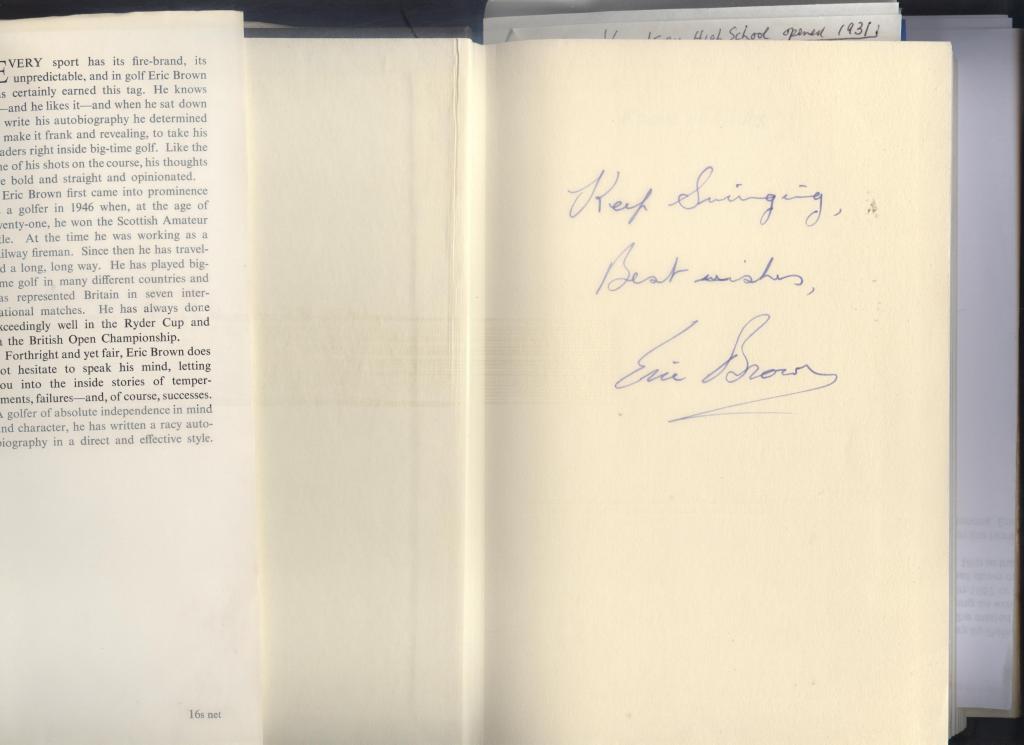
I have a copy inscribed Keep Swinging, Best wishes, Eric Brown
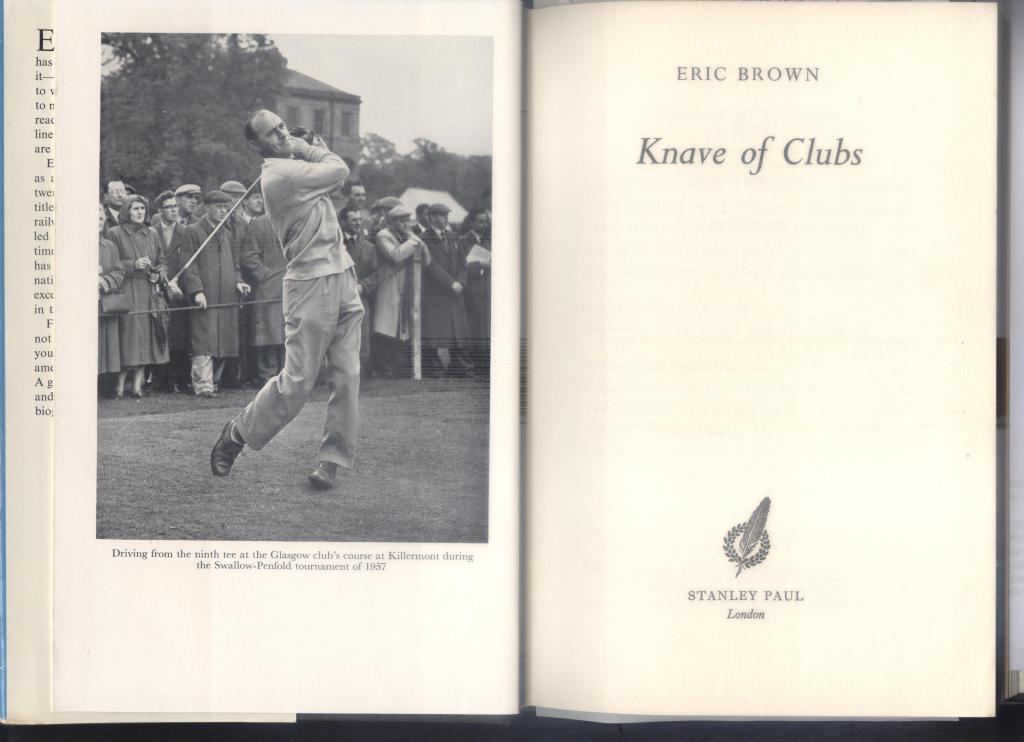
Foreword: I’ve decided to write it myself, for no one knows Eric Chalmers Brown better than I do.
If I convey the impression that I think I’m one of the best golfers Scotland has produced, I won’t feel the need to be apologetic…
Chapter 2 p42:
I was born…at Roseburn Street, Edinburgh, on 15 February 1925… Hearts have always been the football team for me. [Eric died on 6th March, 1986. At that time he was living in Ravelston Dykes, Edinburgh. This is quite close to where he was born.]
After the First World War my father, George Brown, who had been a wood-carver and cabinet maker, took a course at a training college and became a technical-subjects teacher. When I was only fifteen months old he was appointed to a school in Bathgate…our new home in Stuart Terrace lay off the main road; beyond it were the railway line and the local golf course. Because the course was so handy, Dad thought it would be a pity not to take up golf… and my Mother decided to learn to play the game herself. And as my Father was out all day teaching, and my older brother Alex and my sister Betty were at school, my Mother would take me round the course with her… there was myself, a four-year-old armed with a cut-down hickory-shafted club and an old ball… delighted when I hit the ball a dozen yards or so. But schooldays were soon upon me… [Bernard Gallacher also lived for a time in Stuart Terrace. It is a remarkable fact that this one street in Bathgate produced two Ryder Cup Captains.]
My Father, a very strict and determined man, from whom I must have inherited my dour nature, promptly let me know that school came first and golf second.
- was thirteen, and in that year, 1938, something tremendous happened. As a junior member of the Bathgate Club I had begun to blossom out as a player, but when I won the county boys’ championship I caused a real stir in the district. The trophy was the Walker Cup. It had been donated by Mr Andrew Walker, who with his brothers owned a string of grocery stores in the district. The county in general and Bathgate in particular owe a great debt to Mr Walker for the efforts he made to stimulate the game in the area… now he is president of the Scottish Golf Union.
[In 1939, Eric was runner-up in the County Championship to John Anderson. He then went to Carnoustie to complete in the British Boys’ Championship. He reached the fourth round before being beaten by an older internationalist named Pringle. He regained the County Championship in 1940. His round of 69 was the lowest-ever winning score. Eric then played in the Eden Tournament at St Andrews. He qualified for the match-play part of the tournament by coming second in the handicap section. In the first round of match-play he lost at the 17th to Andrew Dowie, a Walker Cup trialist.]
In 1940 I changed schools, and Father became my teacher in the classroom as well as out of it.
[Eric Brown attended the primary department of Bathgate Academy. The Primary 5 (Qualifying Class) teacher, Miss Nicholson, once told us that she would often see him sitting in the front row holding his pencil as if it was a putter and lining up putts on his desk-top. When Eric changed schools he went to the Lindsay High School (opened 1931). If he went from the Academy primary to the Lindsay he would have changed schools in 1937. If he did change schools in 1940 he would have been 15 years-old. ] Father was in the forefront of the school football teams’ arrangements and was also a leading organiser of the school and county sports. One of his happiest days – and one of mine – was when I won the school sport championship for the second time… entering for every event and winning all of them.
By this time my father was beginning to fail in health, and after my brother joined the R.A.F. and my sister the A.T.S., it was decided that when I left school I should get a job that would keep me at home. I joined the cleaning staff of the L.N.E.R. locomotive depot. It wasn’t very long before I qualified as a fireman… I joined the Air Training Corps. We had a fine football team. Two of my team mates were Jimmy Scoular, who became a Newcastle United and Scottish international player and is now player-manager of Bradford, and Rolando Ugolini, the present Dundee United goalkeeper, who formerly played for Celtic and Middlesbrough.
One day in September 1944 the world seemed to collapse all around me – my father died. No one has ever had a better father. One of the sorrows of my life has been that he did not live to see the results of his labours to make me more than an ordinary golfer.
[I joined Durhamtown Rangers and we] had been drawn to meet St Mary’s [Bathgate] in the sixth round of the Scottish Juvenile Cup. We played two drawn games, the score being 2-2 each time, before the Rangers won 3-2. We were defeated two rounds later and Durhamtown Rangers folded up. I had a spell with a very good juvenile side, Edinburgh Waverley… then I joined our local junior team Bathgate Thistle.
Occasionally during the latter stages of the war three of my friends and I spent a day playing over one of the Edinburgh courses. We all agreed that our favourite day out was when we went to the Dalmahoy club… I joined Dalmahoy. What I liked about Dalmahoy apart from the fact that it improved my long-iron play was the graciousness with which the really good players in the club gave me a game. This was quite a change from my home club at Bathgate where the top-notchers wouldn’t have me at any price. Whether this was because of the fear of being beaten, because I was only a fireman, or because I was a cocky young fellow, I don’t suppose I’ll ever know. I had my bad moments at Bathgate as well as the good, but despite the bad ones, some of which I had no doubt brought upon myself, I shall always think fondly of the place.
[One of the good players at Dalmahoy may have been Dale Smith of Broxburn. He was a real character with a great swing.]
In the spring of 1946 my mother told me that she had entered me for the Scottish Amateur Championship at Carnoustie. She gave me £30 to buy a new set of clubs. I bought them from Forgan’s in St Andrews. With the little money I had of my own I added a putter. I had arranged to stay at Montrose because I had relatives there. My cousin’s husband, Albert Hawkins, was my caddie. I finished the first qualifying round with a 73. As Albert and I walked across to the clubhouse we heard one internationalist say to another, ‘Some bloke Brown has just come in with a 73 to lead the field.’ The other replied, ‘Oh, we’ll never hear of him again.’ In the third round I beat Andrew Dowie. He became like a second father to me. He was always ready to put his hand in his pocket and slip me a ‘sub’ and he was always free with good advice and encouragement…In the final I met Robin Rutherford and I won 3 and 2 over thirty-six holes. I was twenty-one years’ old.
When I arrived home in Bathgate the welcome I got from my mother was as precious to me as the winning of any championship. ‘I knew you would win, she said, ‘ when you beat Andrew Dowie.’ And then I told her that I had one burning ambition now, to make golf my life.
[When Eric won the Scottish Amateur Championship he evidently irritated his opponents by the very effective use of low run-up shots from off the greens.]
Chapter 3 p63:
I wrote to seventeen clubs who had advertised for a professional, and received only two replies, both stating that the position had been filled…Willie Allison, a well-known Scottish sports journalist, helped to get me fixed up as an assistant to Harry Fernie at the Northumberland Golf Club in Newcastle. Mr Fernie was a bit like myself – after all, he was a Scot too – and had just about as fiery a temper…I was never defeated over the Gosforth Park course… there was friction between Mr Fernie and myself. My main complaint was that I saw far more of the shop and workbench than I did of the course. So after ten months at the Northumberland club I decided to quit…despite all our differences, Mr Fernie wasn’t anxious to let me go, and tried to talk me into staying on…Willie Allison came to my rescue again and got me fixed up with John Letters and Company, the golf-club manufacturers in Glasgow. Living in Bathgate and working in Glasgow meant a day of very long hours… the late Mr John Letters was very good to me and let me have days off for the Alliance matches during the winter and for the East of Scotland professional golfers’ events in the summer… I was still with the Letters firm when I first met and played that great golfer and buddy of mine, John Panton. The annual East of Scotland Alliance v. West of Scotland Alliance match was arranged for my old course, Dalmahoy. [I arranged to play Panton in the singles. I was one up at the 11th.] Thereafter we halved every hole in par figures, and I had beaten John Panton, Scotland’s greatest golfer.
Midway through 1949… the professional’s job at Haggs Castle, one of Glasgow’s top courses, became vacant, and I was given the job. [To stock the shop my mother gave me £100.] That backing made all the difference in the world. [P.G.A. rules were that you had to be a professional for five years before being allowed to compete in tournaments. Eric complained bitterly about this rule.] I shouted my head off and became known as a rebel, but I didn’t care a button.
Three years afterwards when I was at Sandy Lodge, and just after I had completed my five years as a professional and become eligible to play in all the P.G.A. Tournaments, the members of Sandy Lodge started a subscription list for my expenses in the Open championship of that year. P.B. (‘Laddie’) Lucas, a Member of Parliament and the British Walker Cup captain of 1949, described the subscription as a ‘note of sympathy for Brown for the five lost tournament years of his life and as an unspoken protest against the ludicrous P.G.A. closed-shop rule’. [Besides being a superb golfer Laddie Lucas C.B.E., D.S.O. and Bar, D.F.C. was a hero of World War II. He got his nickname from Highland soldiers stationed where he was brought up in Kent. They referred to him as ‘the wee laddie’. (See: www.raf.mod.uk/rafgolf/Administration/laddielucas.cfm)]
At the 1960 annual general meeting of the P.G.A. it was agreed that the embargo be reduced to six months. But until I at last was received into full P.G.A. Membership I had to travel far and wide away from Britain in order to get tournament experience. The only P.G.A. Tournament available to me was the Open championship, though I was able to play in many much less important events in Scotland. The most worthy of these was the Northern Open championship.
It was in 1950 that I decided to make my first trip overseas. Hector Thomson, another ‘outsider’, and I agreed to make a tour of the Continent and try to get among the money in the Open championships there. Hector and I agreed that any prize money would be split fifty-fifty. [Eric came second equal in the Dutch Open winning £120. He also played in the Belgian and French Opens. Hector and he got some prize money in the Belgian Open and he praised the Belgian Golf Federation for paying their hotel bills. Roberto de Vicenzo (Argentina) won all three events. In September, Eric went alone to play in the Swiss Open. Here, he was looked after and again competed against Jean Baptiste Ado, a hero of the French Resistance. Eric came joint second. Eric then played in the Italian Open where he came third.] In later years I returned time and again to the countries I had visited for the first time in 1950. In 1951 I won the Swiss Open; was runner-up in the Italian Open; and was third in the French, Belgian and Dutch Opens. In 1952 I won the Italian Open and in 1953 the Portuguese Open. In 1956 I was beaten for the German title after a second play-off with Flory van Donck.
[In 1950 Eric went to Rothesay to play in the Bute Championship. Here, he met Joan Fisher from Belfast. They were married in August, 1951.]
Chapter 4 p78:
Since 1950 the Northern Open amateur and professional championship over seventy-two holes which is always played in April has been won only once by a player [George Will of St Andrews in 1958] other than John Panton or myself.
[At one Northern Open at Royal Aberdeen, Eric’s wife was not allowed into the clubhouse so Eric withdrew from the competition. However, he did end up playing.]
Chapter 5 p101:
I had been a full member of the Professional Golfers’ Association less than five weeks when I won my first tournament under their auspices. Looking back over the years I don’t think any victory has given me more satisfaction than that in the Penfold 2000 Guineas event at Maesdu, Llandudno, in May of 1952. [Eric beat Laurie Aytoun of St Andrews in the final.]
Chapter 6 p105:
To the best of my recollection I have had a hole in one only five times – and only once in a tournament or championship. That was at Belvoir Park, Belfast, in the Irish Open championship in 1953…My 272 was a record for the championship. And I’m still the Irish Open champion, for the event was discontinued in 1953.
Chapter 7 p106:
[In 1956, Eric came second in the Dunlop Masters’ to Christy O’Connor.] This was the fourth tournament in 1956 in which I had finished second, the others being the P.G.A. Close championship, the Northern Open, and the German Open. [Eric won the Masters’ the following year.]
I started the Masters’ of 1957 as I had done in the tournament of the previous year. The Holliwell course of the Notts Golf Club had not long been lengthened to 6931 yards, but I romped round in 64, a new record. That first round of mine was described in several newspapers as one of the finest seen in Britain for many years… I was the first home Scot to win the Masters’ tournament, and the success clinched for me the winning of the Vardon Trophy, which is awarded to the player who finishes top of the order of merit pointage table for the season’s tournaments.
[In 1958, Eric played an exhibition match at Bathgate with Matt Ronald (Club Champion) and Jock Duff (County Champion). Eric’s brother Alex (Sandy) stood in as a late replacement for John Panton. I seem to remember that Eric had a three at the 16th. (Drive, long iron, one putt.) At the 18th, my brother recalls Eric throwing his ball down on the tee and almost driving the green. Jock Duff drove his ball a few yards past him. The photograph from left to right on p201 of ‘The Bathgate Book’ shows Sandy Brown, Matt Ronald, Eric Brown and Jock Duff. John Harkins, who lived in Stuart Terrace, is between Matt Ronald and Eric Brown.]
Chapter 8 p113:
I’ve tied for quite a few tournaments or championships – with John Panton in particular in Scotland – but none has been more exciting than that in the Yorkshire Evening News tournament at Moortown in 1958. There was no play-off in that tournament and Harold Henning (South Africa) and I shared the first and second prizes.
Chapter 9 p114:
My last success in a major tournament in Britain was in the News of the World match-play championship at Turnberry in the autumn of 1960. [Eric beat Harry Weetman in the final.]
Chapter 10 p120:
The open has really been a ‘bogie’ tournament for me.
[Before his first Open at Hoylake in 1947 he injured his hand when it was caught in a taxi door. He had no success at Muirfield in 1948 and he did not enter at Sandwich in 1949. In 1950 at Troon, while professional at Haggs Castle, he finished thirteen strokes behind Bobby Locke. He met with no success at Portrush in 1951. In 1952 at Lytham and St Anne’s he finished eleven behind Locke though after two rounds he was in fourth place with 143. In that year he was professional at Sandy Lodge.
In 1953, soon after Eric left Hartsbourne, the Open was played at Carnoustie.]
I had my first view of fabulous Ben Hogan, whose courage was as great as his golf.
[A film Follow the Sun: the Ben Hogan Story (1951) tells of his recovery from serious injuries received in a car crash, and of his victory in the US Open of 1951. Glenn Ford, being a good golfer, played the part of Hogan. This film came to Bathgate and all or most of the golfers in the town went to see it.
Eric was joint leader at the half-way stage with 142 but ended up in ninth place, ten strokes behind Hogan. Eric failed to qualify at Royal Birkdale in 1954. In 1955 Eric was professional at Buchanan Castle. The Open was played at St Andrews and Eric was joint leader at the half-way stage. He finished seven strokes behind Peter Thomson. In 1956 Eric failed to qualify for the Open at Hoylake. In 1957 the Open returned to St Andrews. Again, Eric led at the half-way stage but Bobby Locke won the championship with 279 and Eric was third with 283. In 1958, the Open was held at Royal Lytham. Eric was third on 279 one stroke behind Peter Thomson and Dave Thomas. Thomson won the play-off. At Muirfield in 1959, Eric withdrew after one round with severe fibrositis. Gary Player won the Open that year. In 1960, at St Andrews, Eric finished eight strokes behind Kel Nagle.]
Chapter 1, p9:
Since the Ryder Cup was instituted in 1927 Britain has beaten the Yanks only three times – in 1929, 1933, and 1957 – and not once in America.
[Eric first appeared in the Ryder Cup (at Wentworth) in 1953. In the foursomes, he and John Panton lost 8 and 7 to Sam Snead and Lloyd Mangrum. In the singles, Eric beat Mangrum 3 and 1. At Palm Springs in 1955, Eric and Syd Scott lost 5 and 4 to Doug Ford and Ted Kroll. In the singles, Eric beat Jerry Barber 3 and 2. At Lindrick in 1957, Eric and Christy O’Connor lost 7 and 6 to Dick Mayer and Tommy Bolt. In a singles match which has gone down in history, Eric beat Bolt 4 and 3.
Peter Alliss in Alliss Through the Looking Glass p175 had something to say about this:
Eric Brown was matched with Tommy Bolt, or as they call him in America, Thunderbolt, because of his violent temper and club-throwing antics. One bright spark said that Brown and Bolt should not bother to play golf, they should stand at twenty paces and just throw clubs at each other.
Bolt, beaten by Brown, said as they walked off, ‘Well, you beat me, but I didn’t enjoy playing against you.’ Brown replied, ‘ No, I shouldn’t (swear word) think you did, for you never had an earthly chance of beating me, and you’re welcome to try again any time.’ By the time he reached the dressing-room, Bolt was really on the boil and there was a remarkable scene in which he sounded off about the crowd and the blatant lack of sportsmanship and bias on their part. When Ed Furgol tried to calm him down, Bolt rounded on his own team with a torrent of language… At the dinner after the match, Jackie Burke, the American captain said, ‘Scotland might have taught America golf in the first place but that the time had come when they wished they had not bothered to learn.’
In truth, there was no lasting animosity between Eric and Tommy Bolt. This is what Eric says in his second book Out of the Bag (1964) p17: ‘Tommy, however, is a real likeable guy and a humorist in his own way. I’ve had many a beer and coffee with him in clubhouses around America and I must say he’s my type of man. He just doesn’t give one hoot for anybody.’
In 1959 the Ryder Cup was played at Palm Desert, California. At this time Eric was troubled with fibrositis. In the foursomes, he and Bernard Hunt lost to Bob Rosburg and Mike Souchak 5 and 4.
In the singles, Eric defeated Cary Middlecoff 4 and 3. ]
So now the unwilling possessor of a deplorable record in Ryder Cup foursomes had become the first golfer to win four Ryder Cup singles and the only one, British or America, with a 100 per cent record over so many matches.
Tailpiece p157
A Prime Minister (Earl Balfour) once said: ‘The wit of man has never invented a pastime equal to golf for its healthful recreation, its pleasurable excitement, and its never-ending source of amusement.’
[As well as golf, Balfour loved philosophy. He is best known for the Balfour Declaration of 1917 which promised the Jews a homeland in Palestine.]
I know I’ve gained much healthful recreation, had more than my share of excitement, and provided, I hope, at least some amusement for the vast knowledgeable golfing public of Britain.
Postscript:
Knave of Clubs was published in 1961. Subsequently, Eric was Ryder Cup captain at Royal Birkdale in 1969 with the competition being tied, and at St Louis in 1971 where the USA won. At Royal Birkdale, Eric would not allow the British and Irish players to help look for American balls which went into the rough. It is interesting to note that Bernard Gallacher played in both matches so Bathgate was doubly represented.
In the Open of 1960, played at St Andrews, he came ninth, and at Royal Birkdale in 1961 he was fifth. In 1960 and 1962, Eric won the News of the World Match-play Championship at Turnberry then at Walton Heath. In the 1960 Dunlop Tournament at Gleneagles, he tied for first place with Ralph Moffitt. In all, Eric won the Scottish P.G.A. Championship eight times, the last win being in 1968.
In his youth, Tony Harman was assistant professional with Eric Brown at Hartsbourne. Harman said of him, ‘He was a stormy character but as good as gold.’
It seems to me that Stuart Terrace, Bathgate, Edinburgh and Scotland can be very proud of Eric Brown.
Addendum:
There is a looser Bathgate connection with golf in that Sir Walter Simpson, son of James Young Simpson, was Captain of the Honourable Society of Edinburgh Golfers. In 1887 he wrote a wonderful book called The Art of Golf. Walter (‘Wattie’ to his father) was very friendly with Robert Louis Stevenson. Stevenson’s An Inland Voyage describes their canoe trip from Antwerp to Pontoise, north-west Paris.
In I Can Remember Robert Louis Stevenson, Sir Robert Simpson says, ‘Stevenson occasionally accompanied my cousins, during successive winters, to Bathgate, where there was a well-known skating pond, and they generally had tea at my father’s house.’
Stevenson says that while staying in the Royal Hotel in the Steelyard, he saw the maid looking out along what is now King Street. He asked what she was after and she said, ‘I’m lookin’ for my lad.’
‘Is that him?’ said Stevenson.
‘Weel, I’ve been lookin’ for him a’ my life and I’ve never seen him yet.’
Acknowledgements: I would like to thank my brother and Anne Thornton – real golfers – who have made many useful contributions to these notes.
Haig Ramsay.
 Bathgate Old Times