From:
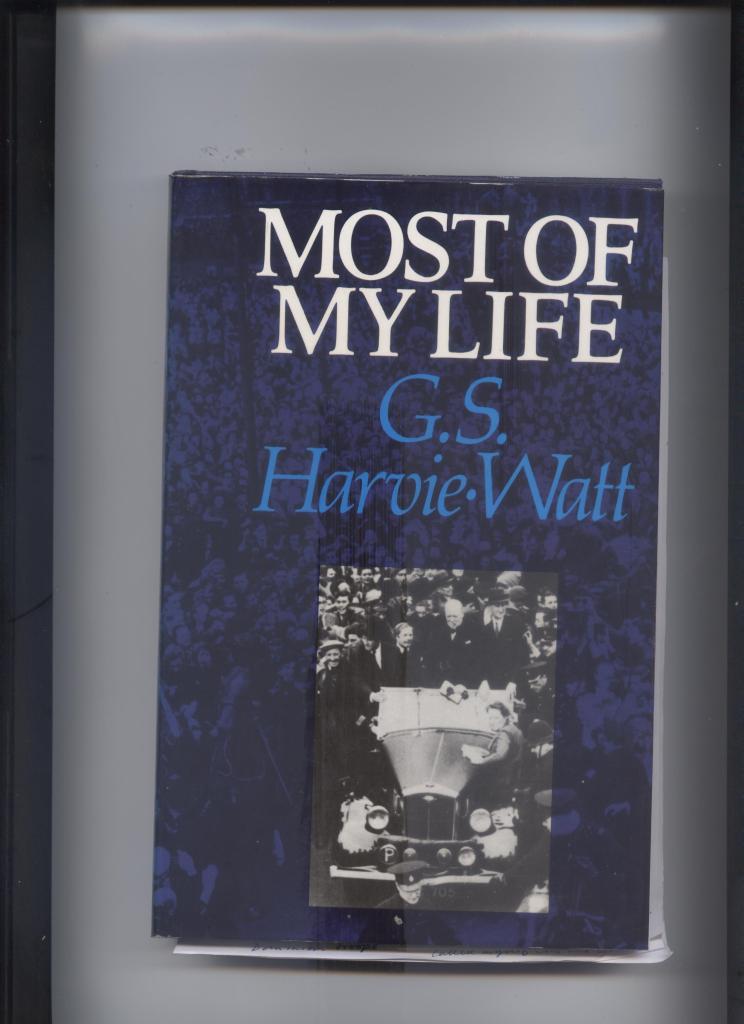
Most of My Life
by
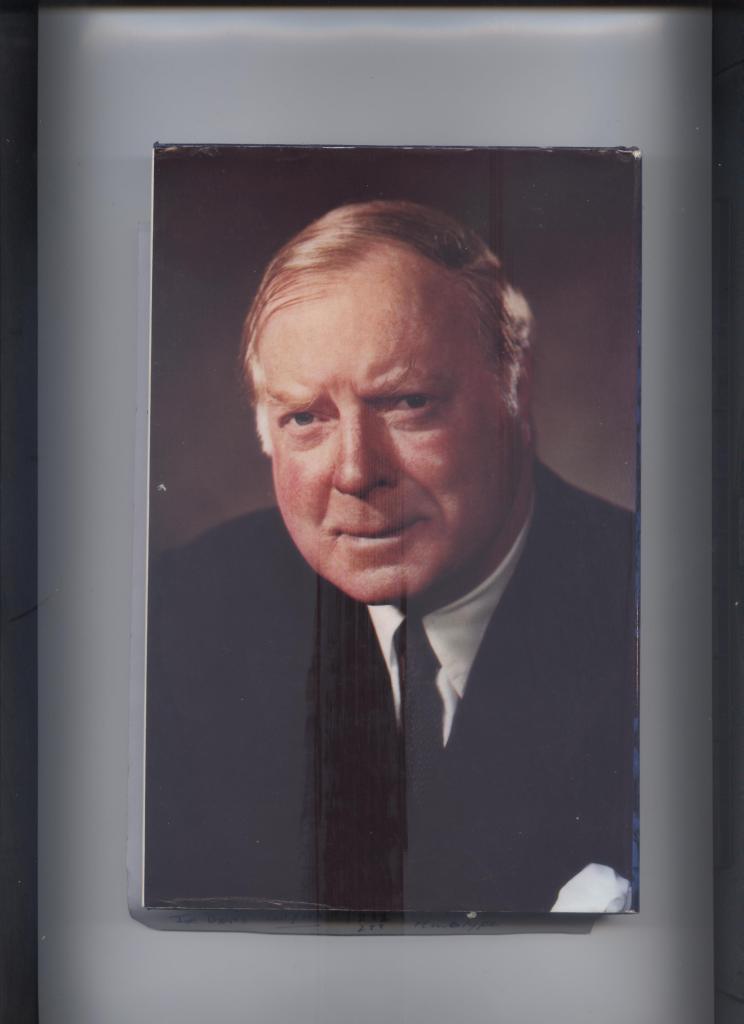
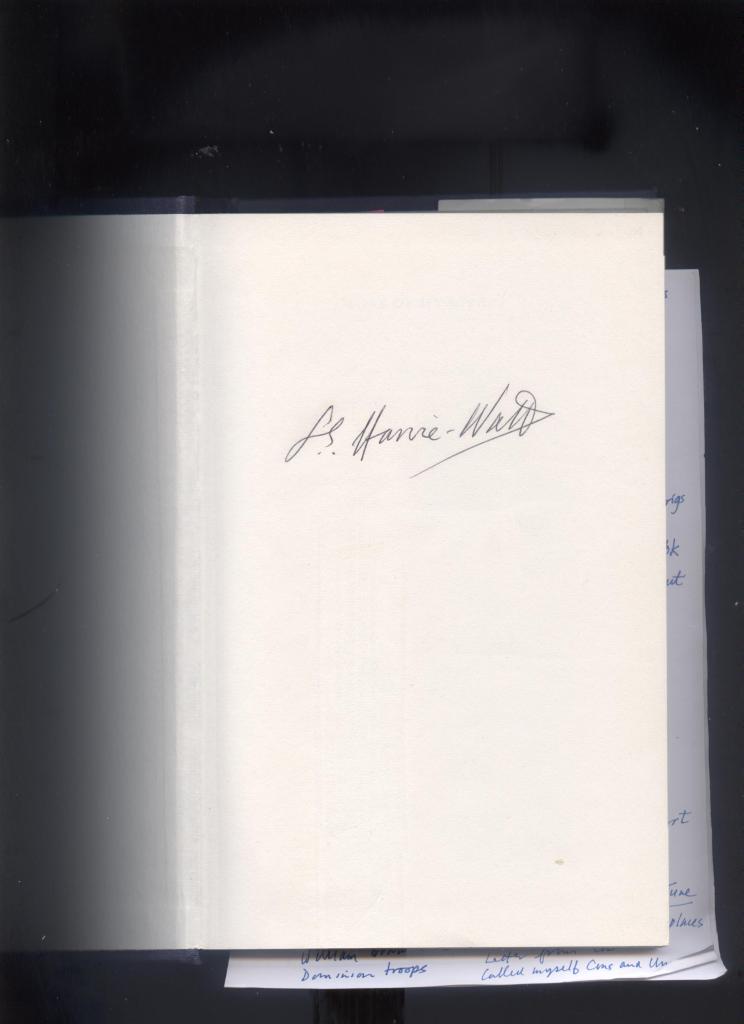
George Steven Harvie-Watt (1903 – 1989)
Baronet of Bathgate (1945 – 1989)
p5:
My early education was received at the local schools – first an infant school run by the Bathgate School Board and then at Bathgate Academy. This school was founded by a native of the town, John Newlands, who had made a fortune in Jamaica.
Some years before World War I my father had joined forces with a friend of his, James Wood of Wallhouse, a coal owner, and a Mr. Cunningham, an engineer, to establish the Atlas Steel Foundry Company in the adjoining town of Armadale, where they soon began to concentrate on the production of steel castings for ships built on the Clyde, and especially turbine castings for which the company became famous.
My time at Bathgate Academy came to an end in 1916 and I was soon alighting from the train at Waverley Station, Edinburgh, to begin my first day at George Watson’s College.
P7:
My school career ended in July 1920. My father was anxious for me to go to the Atlas Steel Works and at any rate give it a try. This I did and I started working on the shop floor. Most of the men I knew because I had often played football with the younger ones and, of course, we were all locals.
At this time I was taking a keen interest in the Boy Scout movement. I increased the size of the troop from one patrol to many, with over sixty boys, and with a pipe band. As the County of Linlithgow champions we attended the Jamboree at Alexandra Palace, where the Prince of Wales inspected us. My troop won the County Championship three times and we were twice in the first six troops fot the Benmore Shield, awarded to the best troop in Scotland.
I had little enthusiasm for the various tasks that I had to do in the machine shop, pattern shop, drawing office, and as a bricklayer’s labourer, and I was glad when after two years it was considered that I should go to the Royal Technical College, then an extramural college of Glasgow University and now Strathclyde University. The subjects I had to study were machine drawing, natural philosophy, mathematics and chemistry. I was bored…
The pleasure and enjoyment at this stage of my career was in joining the O.T.C. In the Engineer Unit at Glasgow University in 1922. I thus started my long connection with the Royal Engineers in the Territorial Army. I was soon promoted to corporal, and, after a course with the Royal Engineers at St. Mary’s Barracks, Chatham, I was promoted sergeant and also took my Certificate A which at that time was the certificate for a commission.
I was commissioned into the 52nd Lowland Scottish Divisional Engineers – a very famous Scottish division – in 1924 and posted to 240 Field Company at Coatdyke. . . The army was to prove the greatest hobby in my life.
During my time at the university I had become more disillusioned with the thought of working in a steel foundry and had quietly transferred to the Faculty of Arts without telling my parents. When I graduated in Arts, taking my degree at Glasgow, my father in particular was furious and said ‘What are you going to do now?’ I replied, ‘Become a barrister.’ This was not at all popular… I was on my way to being called to the English Bar – although I had to put in a final year at Edinburgh University, were English Law was included in the curriculum.
Page 2
When I was at Glasgow University I was at one stage on the Students’ Representative Council. Lord Birkenhead was elected Lord Rector of the University. We had many talks on politics. Birkenhead was the first person to suggest that I should stand for Parliament.
My family upbringing was very much in a political atmosphere since my father was active in the Conservative Party and knew the local Conservative candidate, James Kidd. He beat Manny Shinwell, who was afterwards Member for Linlithgowshire for many years. I knew Shinwell quite well and in later years when I was in the House myself he gave me a very warm and friendly welcome.
It was now time say goodbye to Scotland. I had enrolled at the Inner Temple to read for the English Bar.
I went to London and took digs in Harcourt Terrace, near Earls Court. I made money addressing political meetings at £1 per speech plus expenses. My fees for lecturing at the evening schools were about £1 an hour. It was very hard work, for I also did one or two parades a week with the 56th 1st London Division R.E. at Bethnal Green.
p17
When I came to London I had transferred from the 52nd Lowland Scottish to the 56th (London) Division at the end of 1928 and was promoted to Captain the next year and on 1st January 1935 was given the Brevet of Major. In Scotland the men were largely miners, but in the 56th they were Cockneys with all sorts of occupations. They were a cheerful lot and I enjoyed serving with them.
Whatever I did I always found time for my first love – soldiering. I remained with the 56th Division R.E. Until I left in 1938 to command the 31st Battalion R.E. in AA Command.
p18-19
In the General Election of 1931 I stood for the Conservatives in the constituency of Keighley. There were many rowdy meetings but I loved the heckling. I had been brought up in a tough school in Scotland and I knew something about such meetings and how to overcome the noise and make the audience listen. When the count took place it was one of the most nerve-racking things I had ever experienced. But I won with a majority of 5887. I was only twenty-eight.
p21
I became engaged in April 1932. My fiancee was Bettie Taylor, the only daughter of Paymaster- Captain Archibald Taylor. We arranged to get married at St. Columba’s Church of Scotland on 4th June, a Saturday, by the Rev. Archibald Fleming. [His address at this time was Woodlands House, Armadale. His best man was John Taylor.]
p24
In October 1935 I appeared in the King’s Bench Division for the first time.
p25
In the 1935 General Election I lost my seat in Keighley.
p26-28
In January 1937 I was selected to stand in the by-election for the safe Conservative seat of Richmond, Surrey. I won with a majority of 12 837.
p29
Euan Wallace , Parliamentary Secretary to the Board of Trade, appointed me to be his Parliamentary Private Secretary.
Page 3
p31-32
The Chief Whip, David Margesson, appointed me Assistant Government Whip… The Deputy Chief Whip was James Stuart, who was also the Scottish Whip… I started my duties on 18th May 1938.
p33-34
By the summer of 1938 the international situation was looking grave. I was asked to transfer to the 31st Bn. R.E., an anti-aircraft battalion, with a view to taking command… on 26th September 1938 I was ordered to join my battalion immediately… In January 1939 I was appointed to command the 31st (City of London Rifles) Anti-Aircraft Bn. Royal Engineers.
p36-37
On mobilisation my battalion was spread out over Sussex and Surrey… In August 1940 I was cheered by the birth of my eldest son, James, in Edinburgh.
The raids began in earnest about the early autumn of 1940. Many experiments were made in my battalion area and Lord Dowding often visited my Headquarters with General Sir Frederick Pile G.O.C AA Command.
p41
I was appointed Parliamentary Private Secretary to the Prime Minister, Winston Churchill… I went down to the House with Winston on the morning of 22nd July, 1940.
p48
The next day, before the Cabinet meeting, I met Lord Beaverbrook for the first time. He was quite affable though not particularly so, and he remained like that to me for the duration of the war though our paths frequently crossed. No doubt he sensed I did not like him.
P55-56
I have said that early on in my days at No. 10 I got in contact with many of the Polish exiles. My friend, Harold Mitchell, who was Chief Welfare Officer at AA Command and a liaison officer to General Sikorski, asked my help on several occasions to take an interest in Polish affairs. I was too busy to do much, but if I had the odd leave and happened to be in Scotland I would pay brief visits to his home, Tulliallan, to meet General Sikorski and General Kukiel, C.-in-C. Of Polish Forces, and also Count Lipski.
On several occasions I met a most amusing Colonel of the Cameron Highlanders, Col. Alastair McLean. After the war he was to run the Edinburgh Tattoo with tremendous success. At dinner once at Tulliallan there was a discussion about pipe music. Kukiel asked me if I played because Alastair McLean had just said that he did. I said that I could also play the pipes. McLean thought I was pulling his leg and challenged me to a piping duel after dinner in the Long Gallery. He took his pipes with him wherever he went. I was challenged to play the March Past of the Cameron Highlanders, The Pibroch o’ Donal Dubh. Fortunately although I had not played the pipes for years, this was a tune I knew well so I immediately struck up and marched and counter-marched along the Gallery.
p57
I met Jan Masaryk, the Czech Ambassador… he impressed me tremendously… I saw him a very short time before he went back to his own country where he was assassinated, although there was some pretence that he fell out of a window and committed suicide. I have never believed that story.
P58
Beaverbrook was a natural schemer and he was not popular, especially in the Conservative Party.
Page 4
P61
We went out to the ranges at Princes Risborough where Lord Beaverbrook and Lord Cherwell, and also Sir Alan Brooke, Commander-in-Chief joined us…Beaverbrook walked and talked with me, hanging on my arm. This was the first time he had shown any friendliness to me. He was a great character and a veritable dynamo, although not popular with the politicians.
P77
Churchill had a very soft spot for the Clydesiders, and especially Jimmy Maxton.
P79
Beaverbrook had been dropped from the Administration.This was a great blow to Churchill. He and Beaverbrook had been friends for many years but I don’t think he was a good influence on the P.M., despite his drive and ability.
P83
Here is much praise for the Poles – Sikorski, Anders, Kopanski, Rettinger.
P84
Churchill said that Ulster had been our salvation. The Conservative Party must always stand by Ulster.
P85
Lord Beaverbrook was returning from a trip abroad. . . he could be a nuisance here, stirring up trouble and even running candidates against the Government. The man was a menace and his Second Front speech in America was a great embarrassment.
P94
It was on 8th July 1942 that I first met Generals Eisenhower and Clark. I was much impressed by them.
P96
Air Chief Marshal Harris had a simple philosophy. He was A.O.C. Bomber Command. He said,
‘Never mind the army, navy or fighters – only bombers, bombers and more bombers.’
Poor Harris; despite his brilliant record in the war he thought he had been let down and went to live in South Africa.
P99
Clemmie Churchill was scathing in her criticism of the Ministers Shakes Morrison, Anthony Eden, Jim Thomas, Geoffrey Lloyd, and Clement Attlee. Apart from her comments on Geoffrey Lloyd, her views were shared by me.
P100
When the P.M. got back from the Middle East the Cabinet gave him lunch at the Admiralty. He said that Stalin had a great sense of humour and they got on very well.
page5
P101-103
It was at this time that I was involved in an extraordinary libel action. A storm had burst in certain sections of the Press about a speech I was alleged to have made at a garden party in my constituency in the village of Petersham. (I hadn’t been to Petersham at all at that time,) I was reported to have said our shipping losses were more severe than than the public had been led to know. Was it really wise for Churchill’s Secretary to hint at things the newspapers were not allowed to print? This was in the Daily Herald of August 12th 1942 by Hannen Swaffer, often called the Pope of Fleet Street. This libel was repeated and made even worse in allegations by ‘Cameronian’ in Reynolds News. In the Daily Herald Swaffer wrote ‘Addressing the local Conservatives amid the lovely and spacious grounds of Montrose House, Peterham, he sneered at the advocates of a Second Front by saying that they had never distinguished themselves by any great desire to shoulder arms. In asking how we could could get a million men across the Channel, Watt said, “Our shipping losses are far more severe than we have been led to know so far as the public press is concerned.” Is it really wise for Churchill’s Secretary in the hour of Russia’s agony to denounce as violent political propaganda the Aid for Russia demonstrations which more than anything have proved to Moscow the great goodwill felt by the masses towards our comrades in the Soviet Army?’
In Reynolds News ‘Cameronian’ wrote, ‘Let’s leave mumbo jumbo and take a look at the political mice nibbling industriously at the national morale. For example, Col. Harvie-Watt, in a recent speech commented that advocates of a Second Front had never distinguished themselves by any great desire to shoulder arms…. When Harvie-Watt became Parliamentary Secretary to the Prime Minister, I regretted that a political illiterate should occupy so important a post. So will Winston if he does not sack him.’
Hannen Swaffer and ‘Cameronian’ soon realised their mistake. I accepted the defendants’ apologies. I could have had heavy damages. I never found out who ‘Cameronian was. He hid under his pseudonym; he may have been an embittered Scotsman.
P104 & 106
Edinburgh had been pressing Winston to go up to Scotland to receive the freedom of the capital city. The day was fixed for 12th October. The P.M’s party travelled up on the Thursday night and the P.M. was going to stay the week-end at Dalmeny with Lord Rosebery and his wife. We left King’s Cross at 6.45pm.
The next day my wife met us in Edinburgh. It was a delight to have a couple of free days, to see my parents at Armadale and to be with my own family. On the Monday we drove back to Edinburgh. I collected James Stuart at the New Club and went down to Waverley Station where we were joined by Lord and Lady Rosebery; Tom Johnston, the Secretary of State for Scotland; Ernest Brown; the Chief Constable of Edinburgh; Mr. Winant the United States Ambassador, and the Lord Provost of Edinburgh and his wife. A fellow guest at Dalmeny had been Harry Lauder whom Winston greatly admired. He had discussed with Harry Lauder the question of striking up, with organ accompaniment, his favourite song, Keep Right On To The End Of The Road.
P109-110
More government changes were in the offing. James Stuart said the P.M. and he would be prepared to recommend me for a Governorship or a place in the Government. I turned down the offers and stayed with the P.M. till after the war had ended.
Page 6
P113
The new member of my family, a boy, arrived on Christmas Eve 1942. Winston and Clemmie sent us a very nice telegram of congratulations. We called him Euan, after Euan Wallace whose Parliamentary Secretary I had been. I was glad to be at home for my father was very ill. When I got back from Edinburgh on Christmas Day I went in to see him. He looked up and I told him my wife had had another boy and we were going to call him Euan. He smiled and said, ‘That’s good.’ Those were his last words. He remained in a coma till he died in the first hour of New Year’s Day 1943.
p115-116
Dr Rettinger came to see me. He had just returned from America with General Sikorski. Apparently, according to him, British propaganda in the USA was very bad and American opinion was very much against us. Lord Halifax, according to Rettinger, was not a success.
Early in 1943 I was asked to lunch at the Mansion House by the Lord Mayor to meet General de Gaulle. He wore only one medal and that was the cross of Lorraine. Winston, much later, with a lot of experience of de Gaulle, said that the worst cross he had to bear was the Cross of Lorraine. I must say that, although de Gaulle was a difficult to like, I had the greatest admiration for him as a soldier and a French statesman.
P123-125
I went up to Scotland to my home in Linlithgowshire to see the family for a brief weekend. The main purpose of my visit to Scotland, however, was to see the big football match at Hampden Park. The ground was packed… Lord Rosebery drove me back to Armadale as it was on his way to Dalmeny, his own home.
I got back to London and to No. 10 on the Monday morning. Previously, General McCulloch, Colonel-in-Chief of the HLI, had been in touch with me. Apparently a piper of the regiment had written a pipe tune called Salute to Mr. Churchill and the regiment was very anxious to present it to the P.M. The P.M. had a soft spot for the Scots, for he had served in the RSF in World War I, and asked me to make arrangements for an audition.
I fixed up a suitable date and time. General McCulloch arrived with a piper from the Scots Guards. Admiral Kaufman of the US Navy, Admiral Sir Dudley Pound and Admiral Wake-Walker were with the P.M. in the Cabinet Room. In due course the pipes struck up… the P.M. Thanked the pipe major and said he liked the tune and was very happy to accept it.
Anthony Eden gave a dinner to about a dozen members. He was not at all impressive. He always struck me as being weak and surrounded by ‘yes men’ in the House. He has, of course, plenty of charm but I don’t think he had ever had any real contact with working people. He was like a gilded bird in a gilded cage, with a very petty temper – like a spoiled schoolboy.
I met Maisky, the Russian Ambassador, for the first time, although I had seen him many times at the House. He said, in the course of our talk, that there was no hope for Poland having her eastern territory restored to her and that the Baltic states were Russian. I thought God help Poland and any other country in the hands of the Russian Bear.
Page 7
P127-129
I was at No. 10 when the news of the air disaster at Gibraltar came through. (4th July 1943) General Sikorski and his staff, including Victor Cazalet and Brigadier Whitely, both M.Ps, were on the plane. Apparently the crash took place just after take-off and the plane dived into the sea. There seemed no doubt at the time that the accident was due to sabotage.
There was an article about me in the Star: ‘It is now 1943, it has been a hard job but Members of all parties would readily agree that he has done it well. The first essential for the job is tact and diplomacy and Mr. Harvie-Watt has these qualities, with the result that he has been able to smooth over difficulties and negotiate delicate situations.’
I had to see Winston about Lord Louis Mountbatten. Apparently he had asked Frank Owen, a rabid left wing journalist to be his Public Relations Officer. Winston was furious. He was usually pleased with Mountbatten and had always a soft spot for him. As I left he said, ‘It might not be a bad idea to get rid of Mountbatten.’
p131
I had a long talk with the Chief Whip, James Stuart, about some proposed Government changes, especially regarding Lord Beaverbrook. Winston was anxious to have him back in the Government where he might be less of a nuisance with his endless intrigues.
This appointment was severely criticised. Also, the appointments of Dick Law and Jim Thomas gave the impression that the glamour boys were the only ones going to be recognised by the Prime Minister. Beaverbrook was not popular, although most people admired his driving energy; but it was the ‘glamour boys’, or rather the Anthony Eden circle, who attracted criticism. It was considered that they had no experience to offer the Government because most of them had never needed to earn a penny. They all seemed to be men of wealth.
P133
The fog continued on the next day when I had to meet Lord Linlithgow, at Victoria Station. He was returning from his stint in India. It must have been quite a come-down after living so long in the limelight as Viceroy of India. His home, Hopetoun House, is in my native County of Linlithgow.
For some time I had been sitting for my portrait. The artist was Maurice Codner – a great character and first-class painter, who became President of the Royal Society of Portrait Painters.
P136-137
Mrs Churchill was a very knowledgeable person about politics and political personalities. One of the Members she could not stand was Hore-Belisha. She would rather have Shinwell than Hore-Belisha in the Government and wondered how he would do for the Ministry of Mines.
P141
Tom Johnston, one of the leading Scottish M.Ps on the Socialist side, wanted to see the P.M. because he was anxious that George Mathers, M.P. For my native constituency of Linlithgow, should be appointed Lord High Commissioner to the General Assembly of the Church of Scotland.
P145 page 8
There was some feeling among Members of the House, notably Quintin Hogg, afterwards Lord Hailsham, about what he called Counsels of the Bed Chamber and not the Counsel Chamber. He
thought that Beaverbrook, Bracken and Lord Cherwell were an evil influence on the Prime Minister and were doing him irreparable damage.
P146
Churchill fondled a black cat. He looked up from the cat to me and said , ‘They are lovely friendly creatures. I much prefer them to dogs.’ I just grunted – for I much preferred dogs and couldn’t stand cats.
P149
The next day I went down to the House with the P.M. to hear Shinwell make an imperialist speech in the Dominion Affairs Debate. After it I suggested to Winston that he should make Shinwell Vice-President of the Primrose League. He was quite amused at that idea. I had known Shinwell for many years. I had heckled him when he was fighting as a Socialist candidate in my home constituency of Linlithgowshire in 1924 and in 1929.
[The Primrose League was formed in 1883, in memory of Lord Beaconsfield, (Disraeli) for the maintenance of Conservative principles. The anniversary of Beaconsfield’s death (19th April) is ‘Primrose Day’.]
p150
I glanced along the Front Government Bench to see who was there. Suddenly I was struck by the fact that there were only five of us on the Government Bench and we all came from the same school, George Watson’s College, Edinburgh. (John Anderson, Shakes Morrison, Tommy Cooper, David Maxwell-Fyfe, and myself.) The school also had five Ministers in the Government in 1918-1922.
p151
I had not been at home in Scotland for some time but I went for a long week-end at Easter 1944. It was all so quiet. There had been a few raids in the West of Scotland – very bad ones indeed – and in Edinburgh, but only the odd bomb had dropped in our area of Linlithgowshire and very little damage had been done.
P154
After the war I spoke for Margaret Roberts at her first election. She made a first class speech and dealt with the hecklers magnificently. Little did I know that this young candidate would one day become the Prime Minister as Margaret Thatcher.
P155
I went up to Scotland as I had to dine at Holyrood House during the General Assembly. Lord Linlithgow, dressed as Lord Lieutenant, and Lady Linlithgow were the hosts.
I drove back to Edinburgh the next day as my daughter Rachel was born on the 31st May 1944. I then went to Linlithgow, my county town, where I had lunch with Provost Wright of my native town of Bathgate, Lord Linlithgow, Lord Charles Hope and Mr Crichton, the Convener of the County Council.
P160
I became a good friend of Alfed Munnings, President of the Royal Academy. When he wrote his autobiography in 1951 he sent me a copy duly inscribed, with delightful drawings on the end papers.
Page 9
P162
In July 1944 I was asked by Stanley Christopherson, then Chairman of the Midland Bank, to meet
Mr, Robert Annan and Mr. Geike. Annan was Chairman of Consolidated Gold Fields – a Scot from Lanarkshire and a mining engineer. Geike was also a Scot and a mining engineer.
P164
My family spent their summer holiday at a little seaside place in Fife called Elie. They had been there in 1943 and liked it so much that we bought a house there late in 1944 with entry in the Spring of 1945; it was to become our home where our family was brought up.
P168
At the moment I was a bit fed up with my job. Three years was a long time to work for a prima donna, no matter how brilliant and entertaining he might be.
P170
James Stuart picked me up at the Annexe to go to White’s Club for drinks with Lord Rosebery. We then went on with Arthur Greig to the Dorchester to our St. Andrew’s Night Dinner. The others present were Lord McGowan, Sir Andrew Duncan, Sir Alexander Fleming of penicillin fame, Sir William Douglas, David Maxwell-Fyfe, Sir Andrew Agnew, Alan McDiarmid and McWhirter of the Daily Mail.
While we were having drinks my wife phoned to tell me my daughter Rachel was seriously ill and that Professor McNeil of Edinburgh had been called in. Alex Fleming came over and asked me if I had had bad news and I told him the situation. He asked a few questions, then wrote on a piece of paper, handed it to me and told me to go and phone my wife and get her to tell me the symptoms of my daughter in answer to the questions on his paper and, if necessary, he would go to Scotland that night to see her. Of course, I did this at once.
Shortly afterwards my wife phoned back with the local doctor who was with her. He was an old friend of the family. Alex Fleming took the message which answered his questions and said to me that my daughter would be all right now. She was over the worst but if she was not better I had to let him know at once and he would go up to Scotland himself. I was amazed and terribly impressed by this great-hearted and sympathetic friend.
P178-179
I went home to Scotland for the week-end to attend my daughter’s christening at St. David’s Church, Bathgate, where I was also christened and worshipped with my parents for many years. My daughter was christened Rachel. A lot of my old friends in the district were present.
We heard of the death of Roosevelt. The death of Roosevelt stunned and shocked the House. Members recognised that the P.M. Was affected more particularly and were distressed that this personal sorrow should add to his many heavy burdens at the moment.
P181
There was a very interesting scene in the House when the first-ever Scottish Nationalist took his seat. He was Dr. Robert McIntyre and he had been elected for Motherwell. He didn’t look like a brawny Scot but more like a nervous schoolboy.
Page 10
p183-184
With approach of the end of the war there had been a rush of prospective candidates for interview.
Most of them were colonels and brigadiers, or at any rate officers, and all wanted safe seats… They expected, with no political experience at all, to get a reasonably safe seat because they had rank or title and inherited wealth; they believed that those attributes alone would qualify them to fight and pay for a safe parliamentary seat. I made myself unpopular with a lot of them.
P193
At that stage I was seeing candidates every day and I never ceased to be amazed at the men who had such a good conceit of themselves.
On 8th May the P.M. made his historic broadcast from the Cabinet Room. Victory celebrations were now the order of the day. With an escort of mounted police I then drove with the Prime Minister in an open car to the House of Commons. Nearing Palace Yard a man tried to jump in the car and he landed on my hand and broke a finger.
P194-195
I had developed a severe toothache with suspected abscess. I went to see Dr. Fish, the P.M’s dentist. He called in my old friend, Sir Alexander Fleming of penicillin fame. At once my Scottish mind began to think of what all this was going to cost. I’d never seen so many top brass doctors or dentists before.
That evening I caught the night sleeper to Scotland to spend the week-end with my family and returned to London on Tuesday morning. My toothache had gone and I was back to normal.
Winston told us that after the election James Stuart was to be made Secretary of State for Scotland and I was to be Chief Whip. There was also some talk between the P.M. and James Stuart that I should be recommended for a baronetcy.
P199
The fourth longest Parliament in history was dissolved on Friday 15th June.
P200
During the election, I had first-class meetings, with every hall packed. There was a certain amount of heckling but that I enjoyed. I had been brought up in tough places – mining and industrial areas –
and was capable of facing pretty dangerous mobs but, of course, I had none of that in Richmond or Barnes.
As usual I stood as a Conservative and Unionist Member. I always called myself Unionist; it was a name the Conservatives should never have dropped.
P201
On Saturday evening before the poll I heard that the Prime Minister was going to speak for me in Richmond Green on the following Monday… My wife and I drove with him through my constituency where he spoke to a gigantic crowd on Richmond Green and got a terrific reception.
‘I have come,’ Mr Churchill told the electors, ‘to say a few words on behalf of my friend Harvie-Watt, who has been of great assistance to me throughout the war. I am very glad to come to ask you to give Harvie-Watt your utmost support.’
page 11
p202-203
I had been called to the Bar in 1930 and now in 1945 I was a K.C.. I was indeed a proud man.
The day after the poll I felt deflated and dead tired… we caught the night train for Scotland and our family home, between Bathgate and Armadale. We found my sister was giving a party to welcome us after the election and we didn’t get to bed till well after midnight.
My wife and I went on to our new home in Elie, Fife, where the family, two small boys and a daughter, were waiting excitedly for us.
After nearly three weeks at home I departed for London for the election count. I was elected by a majority of 8 325, a considerable drop compared with my 1937 by-election, but a good result compared with the debacle in the country.
The next day I attended the Prime Minister’s farewell meeting of the Cabinet.
P204-205
I received a letter from Winston written not from No. 10 but from his own home at 67 Westminster Gardens. The letter was dated 10th August 1945 and read – ‘My dear Harvie, I have been granted the privilege of sending in my Resignation List of Honours. It is my intention to submit your name to the King for a Baronetcy and I hope you will allow me to do so.’
On 14th August my baronetcy appeared in the Private Office List – ‘G.S. Harvie-Watt KC, M.P. for Keighley Division of Yorkshire 1931-35 and for Richmond since 1937, Parliamentary Private Secretary to the Prime Minister, Mr. Churchill, 1941-45.’
p206
I carried on as P.P.S. to Mr. Churchill now Leader of the Opposition.
I was elected joint Honorary Treasurer, with Sir Stafford Cripps the Chancellor of the Exchequer, of the Empire Parliamentary Association. This was to be one of my main political interests for the next six years and as to take me to Canada, the United states, Australia and New Zealand.
P207
1945 had been one of the most momentous years in British history. What the House and the nation owed to Winston Churchill can never be fully appreciated. It was also, in a minor way, a memorable one for me. Before the election one paper had written ‘politicians of all parties have been wishing good luck to Brigadier Harvie-Watt in his election campaign and though he is a Conservative his personality is such that few members of other parties will not welcome him back to the House. His Raeburnesque features rarely carry other than a pleasant smile and he is the most approachable of men.’
Page 12
p208-209
Before the war I had been invited to join the Boards of of some gold mining companies, the Globe and Phoenix Group. I had been brought up in a coal mining area of Scotland and had been down nearly every mine in the district. I had been associated with miners from my early days and it was a great and useful experience. In the T.A., when I was serving with the 52nd Lowland Scottish Division Royal Engineers, many of the men were miners from Lanarkshire. They were first-class soldiers and tough.
My interest in mining was given a boost when, just at the end of the war, I was asked by Consolidated Gold Fields of South Africa to join the Board as an outside director. In due course I became the Managing Director, Chief Executive and Chairman of this great company, founded by Cecil Rhodes. I had also been elected to the Board of the Monotype Corporation, a renowned maker of typecasting machinery.
I also found time to go back to soldiering. Towards the end of December 1946 General Browning sent for me regarding the command of a T.A. AA brigade.
Soon afterwards I was appointed an A.D.C. to King George VI. I remained an A.D.C. to the Queen until 1958, when my tour of duty came to an end.
On 1st March 1947 I reported for duty to command the 63rd AA Brigade. Our H.Q. was near Victoria Station. The three regiments in my brigade were the 486 Regt, 490 Regt and the 669 Regt.
P212
I had been in South Africa when the war began, on a visit to the Globe & Phoenix and the Phoenix Prince Mines. In 1947 the companies again wanted me to visit the mines and report on them. My wife and I decided to go by ship. We sailed on the Corinthic from Liverpool. Our companions on board were Mr. and Mrs. Joe Davis, Joe Davis of course being the well-known snooker champion who had been undefeated for twenty years. We remained friends until his death in 1977. The often stayed with us in our home in Scotland.
P215-216
At the Conference of the Empire Parliamentary Association held in London in the autumn of 1948 it was decided to set up a General Secretariat and Council. The offices of the Secretariat were to be situated in London and the General Council would meet in a different part of the Empire each year, the first being arranged for Ottawa in the Spring of 1949.
It was settled that we would leave Liverpool on 16th April. Wives were not included, but as I had relations in nearly every great city in Canada I knew there would be no difficulty with dollars and my wife could spent time with some relative or another while I was on duty.
Photograph facing page 217 shows the Harvie Watt shaft at the Libanon mine and the signpost to the township of Glenharvie (Kloof Gold Mine).
P218-219
On 8th May we left Toronto and flew to Washington where we were welcomed by various Congressmen including Senator Kefauver. With him was his wife Nancy and her father Sir John Piggot of John Brown & Company, the famous shipbuilders on the Clyde. I knew him quite well since he frequently came to Elie for his holidays. Mrs. Kefauver said she often longed for the Elie beach as she was practically brought up on it.
Page 13
In the evening we went to a cocktail party given at the British Embassy by Sir Oliver and Lady Franks. He had been professor of Moral Philosophy at Glasgow University before the war. She also came from Glasgow.
P222-224
The 1950 General Election was held on 23rd February.
My election result was excellent. My vote was 30 907, compared with 1945 when I polled 24 085, and my by-election vote in 1937 of 20 546. My majorities were 13 669 in 1950, 8325 in 1945
and 12 837 at the by-election in 1937.
In Parliament the Socialist majority had shrunk to six.
I was becoming more and more involved with Consolidated Gold Fields. Alas, my army connection came to an end because an Army Council Instruction decreed that no Territorial officer over the rank of Lieut. Colonel could sit in Parliament.
A curious thing which I didn’t learn about until later was that I had been recommended for a C.B.E. in recognition of my services to the T.A. My general said it had been approved at all army levels.
But what about political levels and the above mentioned Army Council Instruction? I have often wondered what happened.
P228
I went to the Commonwealth Conference in New Zealand. At Rotorua I talked to a Maori girl called Miss McPherson Douglas. The Maori chief was a Mr. Mitchell, whose father came from Scotland.
At Wanganui, the next day, two New Zealand Scots invited me to go to the local pipe band practice.
The band played for my benefit a tune called My Ain Highland Home and then asked me to join them. We played All the Blue Bonnets are over the Border, marching up and down the hall. I stayed with the band for supper. I was played off to Auld Lang Syne with a tear in my eye.
P229-230
We went to Wellington for the Commonwealth Conference. The four Scots of the delegation, Shakes Morrison, Alan Gomme-Duncan, Gilbert McAlister and I attended the service at St. Andrew’s Presbyterian Church. On St. Andrew’s Night we were invited to the Town Hall for a Scots National Concert. At least a hundred pipers and drummers were on the platform. Afterwards, many of the audience crowded round us to know where we came from, many with tears in their eyes.
We Scots are a sentimental lot.
P232-234
The General Election was held in October 1951. In Richmond I was returned with a majority of
14 036. The Conservative Party was back in power.
One of my major interests apart from Gold Fields was the Monotype Corporation.
I officially opened the new factory in Dunfermline in August 1961. We transported the parts south for assembly at the Corporation’s main factory at Salfords, Redhill, Surrey. Our chief products were type-setting and type-casting machines.
P235
In 1963 a new system, which does not use conventional methods of type-setting with hot metal, was rapidly gaining ground. The latest instalment of this Monophoto film-setting equipment was handed over at Tonbridge by me, as Chairman of Monotype, to Sir Denis Truscott, Chairman of Brown Knight and Truscott of Dowgate Works, Tonbridge.
Page 14
p237-239
As an outside director of Consolidated Gold Fields, I found myself more and more attracted to its fortunes. In 1950 I felt that was where my future lay. Mr. Robert Annan, Chairman, and Mr. Malcolm Maclachlan, a Managing Director with wide financial experience, suggested that I should become a full-time director. In 1951 I became Managing Director, in 1954 its Deputy Chairman and six months later Chief Executive as well.
In the General Election of 1955 my Conservative majority was 12 955. This was my seventh and last Parliamentary election. I was elected to the Board of the Midland Bank in 1956, the Eagle Star in 1957, and later to the Standard Bank. In March 1958 I announced that I would not be standing for reelection to Parliament.
In June 1958 I was one of the twenty-five Territorial Army Officers presented to the Queen at the Hyde Park Golden Jubilee Parade and Review of the Territorial Army. I had been thirty-six years in the T.A., having joined as a sapper in 1922. I had held every rank up to brigadier, in that time. This was my last parade in the T.A.
P244
In 1960, I succeeded Mr. Annan as Chairman of Gold Fields.
P250
In 1964 the Guardian gave me quite a write-up. ‘In the ten years since Sir George Harvie-Watt Q.C. became responsible for the expansion and diversification of the Consolidated Gold Fields Group its assets have increased from £34 million to something like £100 million and its profits, after tax, from £1.3 million to £4.2 million. In the five years since he was promoted to the Chair, Sir George has risen to the challenge in a way that has caught the City’s attention…’
In the autumn of 1964 my wife cut the first turf at Kloof, the latest gold mine of Consolidated Gold Fields. Kloof has now a town built called Glen Harvie. She had previously cut the first sod at the Harvie-Watt shaft of the Libanon Mine.
P253
1966 was another good year for Gold Fields. It was frequently stated at the time that ‘much of the credit for this dynamic policy of expansion which broadened the groups base and brought rewards to its shareholders must go to Sir George Harvie-Watt who has been responsible for the growth programme for the past twelve years’.
P255
In 1969 when I retired from the Chair of Gold Fields it was the twenty-fifth largest company in Britain at £280 million. The Board was not at all keen for me to retire. I remained a director and became Consultant to the Company till I was seventy. I then became President which I considered a high honour indeed. I continued to be a director of the Midland Bank, the Clydedale Bank, the Standard Bank, the Eagle Star Insurance Company, and the North British Steel Group at Bathgate in Scotland. This company include the Atlas Steel Works founded by my father. In my teens I had several years there as an apprentice mechanical engineer. The North British Steel Group was managed for many years and greatly expanded by an outstanding trio of brothers named Menzies. Sadly, two of them – Douglas and Ian – died prematurely within the last few years, leaving the eldest brother Macbeth Menzies to continue as Chairman, a man well known and respected for his enterprise and leadership.
Page 15
P256
In 1970 I was awarded the Gold Medal of the Institution of Mining and Metallurgy in recognition of of my ‘distinguished services to the world-wide mining industry’.
* * *
 Bathgate Old Times