
Notes on John Fleming
John Fleming (1785-1857) of Bathgate was Scotland’s best zoologist and one of its best botanists and geologists. He wrote 129 books and articles. His name often appears in geological and biological literature. Here are a few examples:
From’ Transactions of the Royal Society of Edinburgh’ volume XXII part III (1861) Memoir by Alexander Bryson:
p655: John Fleming was the third son of Alexander Fleming and Catherine Nimmo and was born at the farm-house of Kirkroads, near Bathgate, on the 10th of January 1785. His father, during John’s boyhood, worked a limestone quarry near at hand. [The farm was opposite the bottom of Council Road (Crosshill Drive).] The quarry, in Petershill Limestone, was probably Glenbare Quarry, later called the First Dub. (There is a low mound running uphill in the field next to Glenbare Court. The mound seems to be artificial so it could be quarry infill or the overburden dump from Glenbare Quarry.) The Petershill Limestone is packed with fossils. John studied these fossils most carefully and named five of them – Corals: Aulophyllum fungites (Looks like a sheep’s horn), Lithostrotion junceum (Looks like spaghetti. Now called Siphonodendron.), and Hexaphyllia marginata (Thin coral with spines). Brachiopod or lamp shell Crurithyris urei, [Named in honour of the Reverend David Ure (1750-1798) ‘The Father of Scottish Palaeontology’ and at one time minister at Uphall.]and a bivalve or mussel Limipecten dissimilis.
p656: Towards the end of 1807 he made a mineralogical tour through Orkney and Shetland, the first fruit of which was a paper on Papa Stour. This paper was communicated to the Wernerian Society, and found a place in the first volume of their transactions… and is worthy of notice on account of having given there, for the first time, the true definition of the term Breccia.
p659: the columnar arrangement of basalt… was due to the effect of shrinkage
p661: in 1814, Fleming read a paper to the Wernerian Society entitled ‘Contributions to the British Fauna’. This communication contains the descriptions of nine animals new to the fauna of the British Islands… He also in the same year communicated a paper describing eight new species of Orthoceratites which he had discovered in the Carboniferous formation of Linlithgowshire. (Orthoceratites are nautiloids with straight shells.)
p665; To Brewster’s Encyclopaedia he furnished the articles on Hybernation, Conchology, Ichthyology, Insecta, Helminthology, Natural History and Aphiology.
P670-671: In 1828 Fleming published his ‘History of British Animals’ which will ever be a monument to his patient and philisophic discrimination. (In this book he described 2107 species both living and extinct.)
p674: (John Fleming died from the effects of a perforated ulcer on Wednesday, 18th November, 1857) At his funeral which took place on the 24th November, all the students of the New College were present; and he was interred in the Dean Cemetery, close to his friend Professor Edward Forbes… The most marked features of Fleming’s mind were his love of truth, his distrust of speculation, and the force and clearness of his reason… Those who came to him with the ostentatious display of their acquirements he froze; but to others who came in doubt or ignorance, he was all warmth and geniality.
John Fleming’s last book, ‘The Lithology of Edinburgh’ (1859) contains a Memoir on his life written by John Duns [John Duns was born in Duns in 1820 and was minister at Torphichen 1844-1864. He then became Professor of Natural History in New College. Oddly enough, the Chair of Natural History then went to James Young Simpson (1873-1934) son of the nephew of Bathgate’s James Young Simpson.] From the Memoir:
page V: Taking the Kirkroads cottages as a centre, and limiting the view to a radius of a mile, at least three fossiliferous limestones occur…[East Kirkton, West Kirkton and Petershill Limestones]
The botanical riches of the neighbourhood were pointed out by Mr Fleming himself in the ‘Outline of the Flora of Linlithgowshire’.
From ‘The Scots Magazine’ 1809:
p327: The Reverend Mr John Fleming of Bressay laid before the Wernerian Society an outline of the Flora of Linlithgowshire… This, he stated, much to the Society’s satisfaction, was to be considered the first of a series of communications, illustrative of the natural history of his native county.
From ‘Scottish Reminiscences’ (1904) by Archibald Geikie p381:
Dr John Fleming author of the well-known Philosophy of Zoology … never quite adopted the views of modern geologists. I remember him as a tall rather grim figure, full of personal kindness, and gifted with keen critical power. He seemed never to be happier than when he had an opportunity of exercising that power in sarcastically demolishing the arguments of those to whom he was opposed.
From ‘A Long Life’s Work’ (1924) by Archibald Geikie:
p17: Professor John Fleming, the most distinguished naturalist of his day in Scotland, was at this time sixty-five years of age and filled the chair of Natural Science in the New College, Edinburgh. Besides his zoological works which have become classics in science, he has published papers on geological subjects, in which he did not always agree with the general opinion of his day.
p63: ( Before the introduction of the petrological microscope, identifying the minerals in fine-grained igneous rocks was not easy.) In my perplexity I appealed to my old acquaintance Professor Fleming…. He replied that he put … smaller fragments in the bowl of a clay tobacco-pipe, and then thrust the pipe into a brisk fire. The fragments were not melted, but their component minerals could then be more or less distinguished from each other. … But I need not say that this process gave me no real assistance.
From ‘The Dictionary of National Biography:
p280: Fleming had a vein of sarcasm which he allowed to operate somewhat freely, and a way of hitting opponents which could not be very agreeable. But the genuine kindness and honesty of the man came to be appreciated even by those whom, like Buckland, he had once somewhat alienated.
From ‘Edinburgh’s Place in Scientific Progress’ (1921):
p84: The Rev John Fleming (1785-1857) was for many years one of Scotland’s leading naturalists and geologists. His connection with Edinburgh dates from his attending classes at the University in 1802; in 1845 he returned to the city to occupy the Chair of Natural Science in the New College – the Free Church Theological Hall. Fleming, in the summer of 1827, discovered fish remains in the Old Red Sandstone of Fife. Fleming’s researches in the Old Red Sandstone carried him a long way.
… In 1830 the Rev. Dr Fleming of Edinburgh read a paper before the Wernerian Society in which he boldly stated that the Old Red Sandstone is a fresh-water formation of older date than the Carboniferous Limestone.
p114: With the appointment of John Fleming (1785-1857) to the new Chair of Natural History in the Free Church College in 1845, and of Edward Forbes (1815-1854) to that in the University in 1854, zoological teaching in Edinburgh entered upon a new phase. … Fleming’s British Animals (1828) greatly furthered investigation by its conciseness and comprehensiveness, and his simple Philosophy of Zoology (1823), which gained him a European reputation, aimed at converting the study of animals from the fallacies of external resemblance to the deeper truths of general organisation and function.
From ‘Edinburgh and its Neighbourhood’ (1883) by Hugh Miller
p53: I refer of course to the trap-rocks,- that picturesque family to which we owe, with the various islands of the Frith, the Castle, the Calton, and the Craiglockhart Hills, the noble Arthur Seat group, the wooded heights of Corstorphine, and the blue range of the Pentlands.
p55: I need refer to but a few of the other names associated with the singularly instructive phenomena of this trappean group of hills …. Thomas Allan, Hay Cunningham, Mr. Townson, Milne Hume, Dr. Fleming, and Professor Jamieson.
p245: ‘There are a small knot of us,’ said a literary friend, ‘getting up what will be a rather curious volume on the Bass. Professor John Fleming undertakes the zoology of the work; Professor Balfour its botany; … Our expedition still lacks a geologist.’
P263: Dr Fleming, who had been residing for several weeks at North Berwick, had detected on the surfaces of the trap-rocks near the harbour, unequivocal marks of the action of icebergs.
From ‘The Old Red Sandstone’ (1899) by Hugh Miller
p152: The superior Old Red Sandstones of Scotland were first ascertained to be fossiliferous by Professor Fleming of King’s College, Aberdeen, confessedly one of the first naturalists of the age. …
He it was who first discovered, in the Upper Old Red Sandstones of Fifeshire the large scales and plates of Holoptychius. (This is a fossil fish now called Holoptychius flemingi in his honour. On p185 Fleming is quoted as saying that he found the fish scales in Drumdryan Quarry, south of Cupar, in 1827. )
From ‘The Geology and Scenery of the Grampians’ Volume 2 (1908) by Peter Macnair
p13 Passing now to a consideration of the plants which are found in the lower zone of the Old Red Sandstone, we find they belong to two genera, Zosterophyllum and Parka. The grassy looking leaves discovered by Dr. Fleming in 1831 indicate Zosterophyllum. Parka decipiens to which the name was originally given by Fleming, consists of oval or circular masses of disc-shaped bodies.
( Parka decipiens is a very primitive land plant. It was discovered and named by Fleming. He said it looked like compressed raspberries.)
From the ‘History of the Geological Society of Glasgow’ 1858-1908
p128 In 1897 the same authors (James Reid and Peter Macnair) along with Mr. W. Graham, read a paper ‘On the Origin and Affinities of Parka decipiens of Fleming’. The paper gave first a summary
of the different views as to the animal or vegetable nature of this organism since its discovery by Dr Fleming, of Edinburgh, about sixty years ago.
John Fleming appeared as an expert witness for the defenders, James Russel & Son coalmasters, of Falkirk in the famous Torbanehill Case of 1853. The pursuers were Mr & Mrs William Gillespie of Torbanehill,Bathgate.
The defenders had a mineral lease of the lands of Boghead. In 1850 they took a mineral lease of Torbanehill for a period of twenty-five years. Good gas coal was of such high value that seams only 3 inches thick were extracted. The Torbanehill Mineral (also called Boghead Coal or Bathgate Coal) was very rich in volatiles so it was supplied to gasworks in various parts of Scotland. More importantly, it was used by James Young in the oil refinery he set up near Whiteside in February, 1851. The mining company was making such big profits that Mr Gillespie came to the conclusion that this Torbanehill Mineral was not a coal so its extraction was not covered by the mineral lease. The Gillespies took their case to the Court of Session (29 July – 4 August 1853). After hearing evidence from 79 expert witnesses the jury decided that the Torbanehill Mineral was a coal so they found in favour of the mining company. If the jury had decided that the Torbanehill Mineral was not coal, Young’s patents which related to the extraction of oil from coal would not have applied. Young was thus allowed to continue production.
From ‘Gillespie v Russel The Torbanehill Case Reports of the Jury Trial of 1853’
p161 EVIDENCE FOR THE DEFENDERS Dr John Fleming examined
By Mr Neaves.- Q.Dr Fleming, you have for many years directed your attention to Natural Science?
A. I have. … and so on and so on.
(Fleming was cross-examined by the Dean of Faculty for the Pursuers.
P393 ‘Report by Dr John Fleming, Professor of Natural Science, New College, Edinburgh, on Boghead or Torbanehill Cannel Coal.’
P394 Cannel coal.- It is distinguished from the other coals by taking fire easily… Hence the term cannel (the Lancashire of candle)… when laid on the fire it makes a crackling noise. Hence the name parrot coal. Torbanehill Coal is a cannel, parrot or gas coal.
(Fleming’s address at this time is given as Seagrove House, Leith.)
From A History of British Starfishes, 1841, by Edward Forbes:
p164 ECHINIDAE –CIDARITES
FLEMING’S EGG-URCHIN Echinus Flemingii
Professor Agassiz, when examining the collection of Dr. Fleming at Aberdeen in October 1840, recognised in the Echinus miliaris of the “British Animals” the splendid new species before us, first found in deep water in Zetland, and since taken by Mr. Ball, who has long considered it distinct from any described species, off Youghal, on the south-west coast of Ireland, in very deep water, and by him has been named after its discoverer. It is by far the finest British species.
From Elements of Geology, 1838, by Charles Lyell:
p454 A gigantic species of fish of the genus Gyrolepis has also been found by Dr. Fleming in the Old Red sandstone of Fifeshire.
P482 Carboniferous period. – Two classes of contemporaneous trap rocks have been ascertained by
Dr. Fleming to occur in the coal-field of the Forth in Scotland. The newest of these, connected with the higher series of coal-measures, is well exhibited along the shores of the Forth, in Fifeshire, where they consist of basalt with olivine, amygdaloidal greenstone, wacke, and tuff. They appear to have been erupted while the sedimentary strata were in a horizontal position, and to have suffered the same dislocations which those strata have subsequently undergone. In the volcanic tuffs of this age are are found not only fragments of limestone, shale, flinty slate, and sandstone, but also pieces of coal.
The other or older class of carboniferous traps are traced along the south margin of Stratheden, and constitute a ridge parallel with the Ochils, and extending from Stirling to near St. Andrews. They consist almost exclusively of greenstone, becoming in a few instances, earthy and amygdaloidal. They are regularly interstratified with the sandstone, shale, and ironstone of the lower coal-measures, and, on the East Lomond, with Mountain Limestone.*
* Part of this tract I have myself examined with Dr. F.
P484 Dr. Fleming has observed similar trap rocks in the old red sandstone of northern Fifeshire, where they are covered immediately by the yellow sandstone which forms the base of the mountain limestone and coal-measures.
From Principles of Geology 7th Edition, 1847, by Charles Lyell:
p76 On the great vicissitudes of temperature on the earth’s surface see two articles by the Rev. Dr. Fleming, in the Edinburgh New Phil. Journ. No. xii, p277, April 1829; and No xv. P 65, Jan 1830.
p78 Dr. Fleming, in a discussion of the subject [of the distribution of animals] has well remarked that a near resemblance in form and osteological structure is not always followed in the existing creation by a similarity of geographical distribution…and different species of bears thrive in tropical, temperate, and arctic latitudes.
Fleming, Edinburgh New Phil. Journ.., No xii, p 282, 1829.
p288 Submarine Forests. – Among the proofs that the sea has encroached on the land bordering the the estuary of the Tay, Dr. Fleming has mentioned a submarine forest which has been traced for several miles along the northern shore of the county of Fife.
Quart. Journ of Sci., &c., No. xiii. N. S. March, 1830.
p618 Spallanzani calculated that the swallow can fly at the rate of 92 mph, and conceived that the rapidity of the swift might be three times greater.
Fleming, Phil. Zool., vol. ii, p43.
P619 Migrations of the larger reptiles. – Dr. Fleming mentions that an individual of the hawk’s bill turtle (Chelonia imbricata), so common in the American seas has been taken at Papa Stour, one of the West Zetland islands.
Brit. Animals, p149.
P656 The bear which in Wales, was regarded as a beast of the chase equal to the hare or the boar, only perished, as a native of Scotland, in 1057.
Fleming, Edinburgh Phil. Journ., No. xxii, p295.
P742 Cetacea. – It is not uncommon for the larger cetacea to be stranded. Thus a narwhal (Monodon monoceros) was found on the beach near Boston, Lincolnshire, in the year 1800, the whole of its body buried in the mud. A fisherman going to his boat saw the horn and tried to pull it out, when the animal began to stir itself.
Fleming’s Brit. Animals, p 37; in which work may be seen many other cases enumerated.
Links between John Fleming and James Young Simpson (1811 – 1870)
In 1843, the Disruption of the Church of Scotland over the question of Lay Patronage, saw the formation of the Free Church of Scotland. The painting by David Octavius Hill – The First General Assembly of the Free Church of Scotland. Signing the Act of Separation and Deed of Demission, at Tanfield, Edinburgh, May 1843 – shows both John Fleming and James Young Simpson. Here, 396 ministers and professors appended their names. It is a remarkable fact that two of the professors came from Bathgate.
It is also recorded that Thomas Simpson, eldest brother of James Young Simpson married John Fleming’s sister, Catherine. The conclusion can only be that John Fleming and James Young Simpson knew each other.
To see mention of his son Andrew, see Flemings – geological and biological collections
Read about John Fleming’s grandson, Colonel Charles Christie Fleming
Read about John Fleming’s grandson Lt Col J. M. Fleming
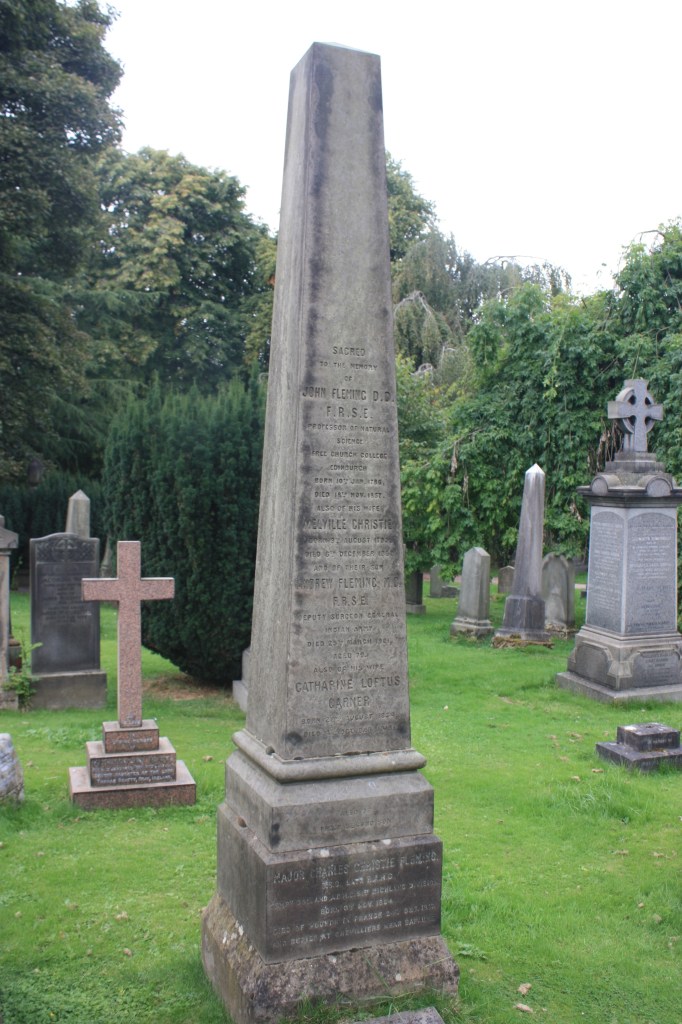
John Fleming’s gravestone, Dean Cemetery, Edinburgh. Photo by Stephen C Dickson
 Bathgate Old Times