From
Record of the International Exhibition 1862
In the British department of the International Exhibition Mr. Young, who must be regarded as the founder of the paraffin industry, exhibits a splendid block of paraffin weighing nearly half a ton, colourless, inodorous, tasteless, and beautifully translucent; he also shows specimens of paraffin candles, and oils made from the Wemyss, Torbane Hill, Wigan, and Newcastle coals; showing that all bituminous coals yield these substances. Mr. Young’s paraffin oil is now very extensively used throughout the United Kingdom as an illuminating agent, for which purpose it is peculiarly well adapted, since it consists mainly of hydrocarbons free from oxygen. These hydrocarbons deposit much carbon on combustion, and hence, with a properly regulated supply of air, they produce a more brilliant light than that obtained by the consumption of an equal amount of animal or vegetable oils, which contain a not inconsiderable amount of oxygen.
The enormous extent of the use of paraffin oil for illuminating purposes may be conceived from the fact, that in the neighbourhood of Edinburgh two years ago, one lamp manufacturer alone had constructed during one year 247 431 lamps exclusively for its consumption, and that he was making them at the rate of 1200 per day.
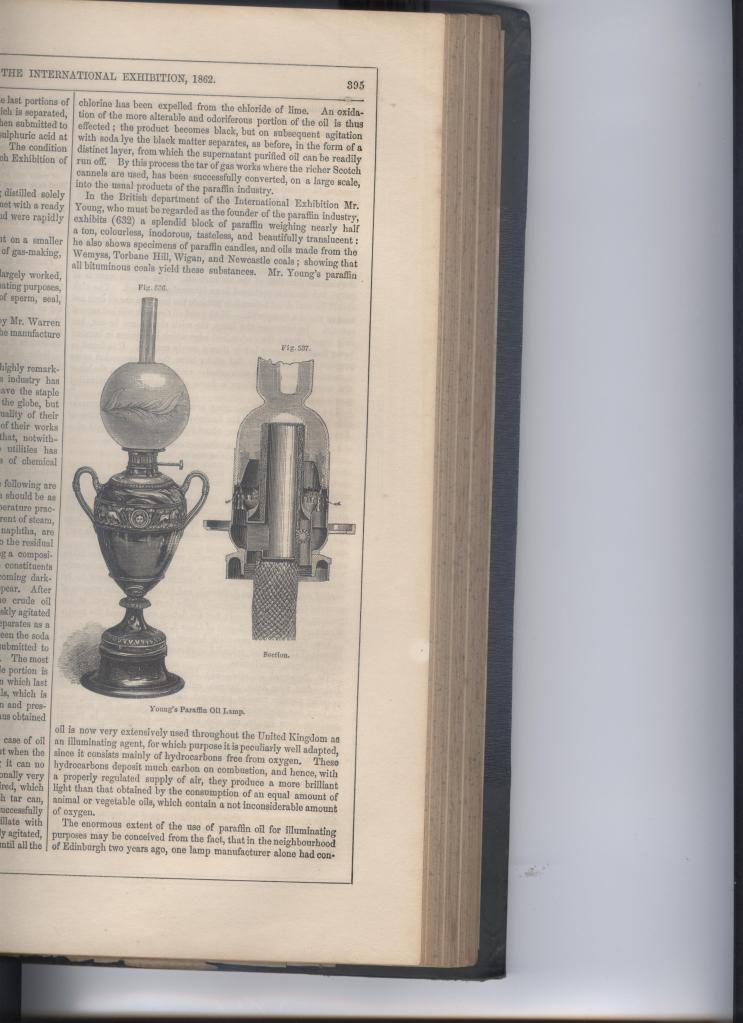
Paraffin oil requires for its combustion lamps of peculiar, but simple construction; thus, the vessel that holds the oil should be glass or stoneware, so that the oil may not become heated, and for the same reason there should be no metallic connection between the burner and the oil. For the perfect combustion of paraffin oil, a more rapid current of air is required than in the case of animal or vegetable oils, and the current must be made to impinge powerfully against the flame, either by surrounding the latter with a brass dome within the glass chimney, or by constriction of the glass chimney itself. Mr. Young exhibits a very elegant paraffin oil lamp of this description, which meets the above requirements. Fig. 536 represents this lamp in elevation, and Fig. 537 shows in section the arrangement of the wickholder and the combustion chamber; the arrows showing the direction of the air currents. The outside vase is of metal, but the oil is contained in an internal glass vessel. The wick should be well dried before it is put into the lamp, as the oil does not readily rise in a damp wick. With good oil the wick will last several months. In trimming the lamp, the wick should not be cut, but only wiped clean; the carbonised edge which it acquires in burning being found to answer better than a newly cut one. It is found in practice that lamps with flat wicks burn the oil somewhat more economically than those with annular wicks; nevertheless, the latter are more convenient where a flame of considerable illuminating power is required.
The comparative illuminating power of paraffin oil is remarkably high. According to Dr. Letheby’s experiments with one gallon of Young’s paraffin oil, weighing about 8.5 lbs., will give the light of –
23.5 lbs. of spermaceti candles; or,
27 lbs. of wax candles; or,
28.25 lbs. of stearic candles; or,
30.25 lbs. of composite candles; or,
40 lbs. of best tallow moulds.
 Bathgate Old Times